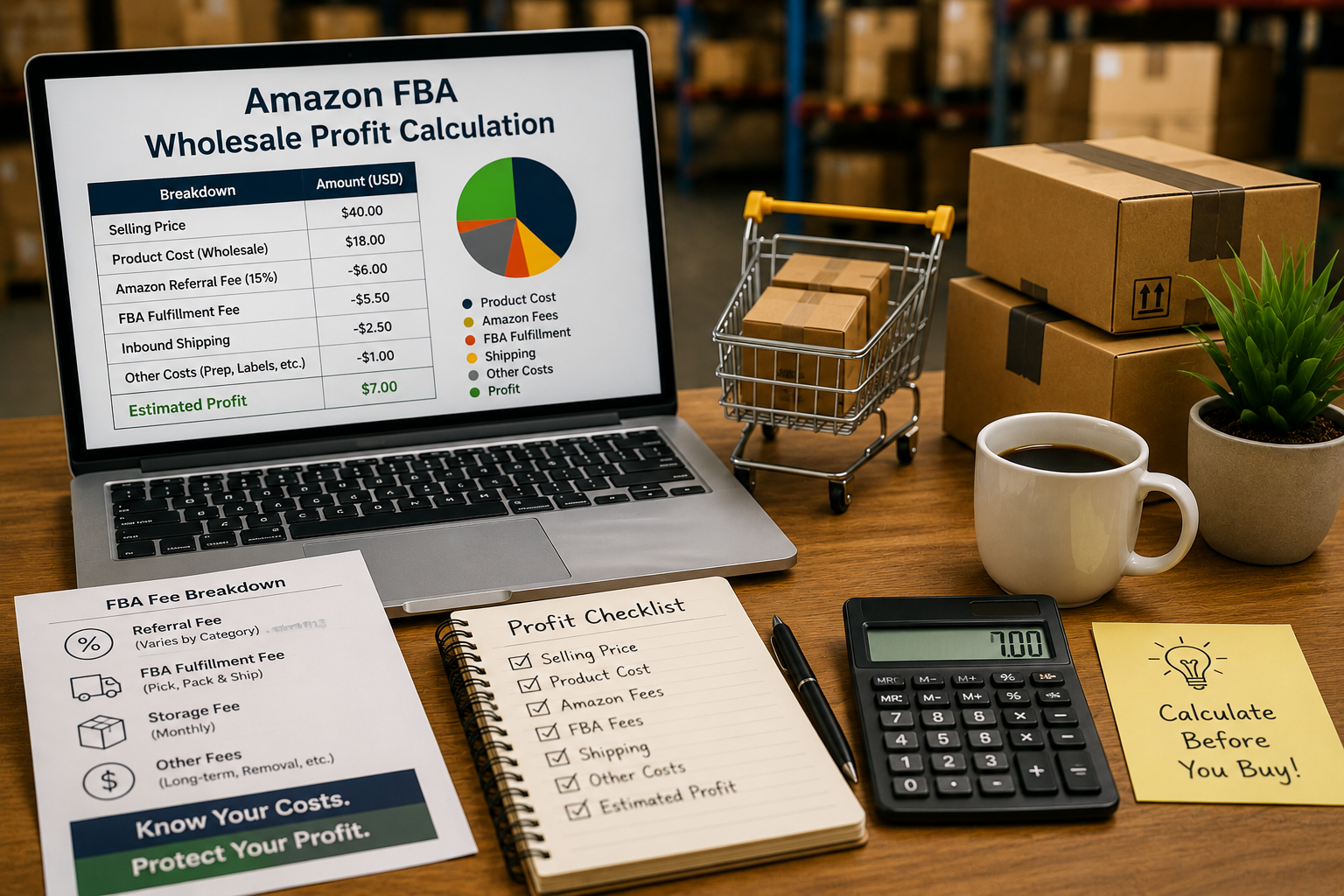
One of the easiest mistakes in Amazon wholesale is confusing revenue with profit.
A product sells for $40.
You buy it for $20.
It looks like a $20 profit.
It isn’t.
Amazon fees, fulfillment, shipping, storage, preparation and other costs can change the calculation significantly.
Amazon currently lists a Professional selling plan at $39.99 per month, while referral fees vary by category. FBA adds fulfillment and storage costs that depend on factors such as product size and weight.
So before buying wholesale inventory, calculate the whole picture.
The Basic Amazon Wholesale Profit Formula
Use:
Selling Price – Product Cost – Amazon Fees – FBA Costs – Shipping/Prep = Estimated Profit
For a more realistic business calculation, you can also account for:
- Returns
- Advertising
- Storage
- Damaged inventory
- Taxes
- Currency costs
- Other operating expenses
Example
Imagine a product sells for:
$35
Your estimated costs:
| Cost | Amount |
|---|---|
| Selling price | $35 |
| Wholesale cost | $15 |
| Amazon fees | $8 |
| Inbound shipping/prep | $3 |
| Estimated profit | $9 |
That gives you approximately $9 per unit before other business expenses.
If you sell 100 units:
$9 × 100 = $900
But don’t stop there.
If sales slow down and inventory sits for months, your real return on the money invested changes.
Use Amazon’s Revenue Calculator
Amazon provides a Revenue Calculator that allows sellers to compare FBA with their own fulfillment method using product price, dimensions, weight, category and shipping information. Amazon specifically recommends it for estimating margins.
This is much safer than using an old fee table from a random blog.
Why Product Size Matters
A $30 product isn’t automatically better than a $20 product.
Suppose:
Product A: $30 selling price, small and light
Product B: $40 selling price, large and heavy
Product B may generate more revenue but cost more to fulfill and store.
Amazon says FBA fulfillment costs depend on product size, weight and related factors, while storage is based on the space inventory occupies in Amazon’s fulfillment network.
That is why product dimensions belong in your profit calculation from day one.
Don’t Forget the Wholesale Cost
Your supplier’s price should include everything you actually pay to get the inventory ready for sale.
Ask whether your quote includes:
- Product cost
- Shipping
- Handling
- Packaging
- Preparation
- Other supplier charges
A $12 product that becomes $15 after shipping is not really a $12 product for your calculation.
What Is a Good Amazon Wholesale Margin?
There is no universal margin that works for every Amazon seller.
Your target depends on:
- Category
- Product size
- Competition
- Advertising
- Return rate
- Inventory speed
- Supplier pricing
- Cash-flow requirements
Instead of chasing a random “20%” or “30%” number, calculate the actual contribution per unit and then consider how quickly you can sell it.
Amazon’s 2026 Fee Changes
Amazon announced that U.S. referral and FBA fees would increase by an average of approximately $0.08 per unit sold in 2026, which Amazon described as less than 0.5% of the average selling price.
That may sound small, but if you’re selling thousands of units, small per-unit changes can add up.
This is why profit calculations should be updated regularly.
A Better Way to Judge Products
Instead of asking:
“How much can I make?”
Ask:
“How much do I make after every realistic cost, and how quickly can I recover my inventory investment?”
That question gives you a much better picture of the business.
Final Takeaway
Before ordering wholesale inventory, calculate:
Selling price + Amazon fees + FBA + shipping + product cost + expected inventory time
Then decide.
Not before.
For more information about the complete business model, connect this article to your Amazon FBA wholesale pillar.
FAQs
How do I calculate Amazon FBA wholesale profit?
Subtract product cost, Amazon selling fees, FBA costs and inbound expenses from your expected selling price.
Does Amazon FBA include storage costs?
Yes. FBA includes storage costs that depend on the amount of inventory space used.
Does Amazon provide a profit calculator?
Yes. Amazon’s Revenue Calculator can compare estimated FBA and self-fulfillment costs.