Amazon FBA Wholesale: What Does It Actually Mean?
Amazon FBA wholesale is fairly simple in theory:
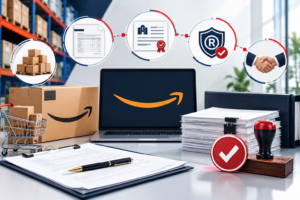
You buy established products in bulk from a legitimate wholesale supplier, list those products on Amazon, and use Fulfillment by Amazon FBA to store and ship your inventory.
The difficult part is not creating the Amazon listing.
The difficult part is finding products that still make sense after product cost, Amazon fees, competition, shipping and inventory costs are included.
That is where most of the real work happens.
Is Amazon FBA Wholesale Still Worth It in 2026?
There is still a large independent-seller market on Amazon.
Amazon’s 2025 data shows:
- More than 60% of Amazon store sales came from independent sellers.
- 75,000+ independent sellers passed $1 million in sales in 2025.
- U.S. independent sellers averaged more than $375,000 in annual sales.
- U.S. independent sellers sold 4.6 billion+ products in 2025 — more than 8,900 products per minute.
These numbers show the size of the marketplace, not what a new seller should expect to earn.
That distinction matters.
A seller doing $375,000 in revenue may have a completely different profit situation from another seller doing the same revenue.
Revenue is not profit.
What Makes Amazon FBA Wholesale Different?
With private label, you are normally building a product and brand.
With wholesale, you’re working with products that already exist.
That can give you some advantages:
- Existing customer demand
- Established brands
- Existing Amazon listings
- Less product-development work
- Potential for repeat purchases
- Ability to build a portfolio instead of depending on one product
But there is a trade-off:
You are usually competing with other sellers selling the same product.
So your sourcing price matters a lot.
The 5 Things I Would Check Before Buying Wholesale Inventory
If you’re new to Amazon FBA wholesale, don’t start with the supplier’s price list.
Start with the Amazon listing.
1. Selling Price
Check what the product is actually selling for—not just the highest current price.
2. Competition
Look at:
- Number of sellers
- Buy Box situation
- Price changes
- Amazon’s presence on the listing
- Review strength
3. Amazon Fees
This is where many beginner calculations go wrong.
Amazon’s current U.S. pricing structure includes selling-plan fees, referral fees and optional FBA-related costs. For example, Amazon currently lists the Professional selling plan at $39.99/month, while referral fees vary by category.
For example, Amazon currently lists:
- Home & Kitchen: 15% referral fee
- Pet Supplies: 15% in most cases
- Toys & Games: 15%
- Grocery & Gourmet: 8% for products priced at $15 or less and 15% above $15.
And that’s before considering FBA costs.
4. Product Cost
Now compare the actual wholesale cost with your realistic selling price.
5. Inventory Speed
A product that makes $8 but sells 100 units a month may be more useful than a product that makes $20 but sells only five.
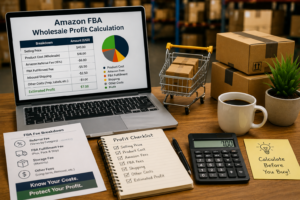
A Simple Amazon Wholesale Profit Example
Let’s say you find a product selling for $35.
Your estimated numbers are:
| Cost | Amount |
|---|---|
| Selling price | $35 |
| Wholesale cost | $16 |
| Amazon fees | $9 |
| Shipping/prep | $3 |
| Estimated profit | $7 |
That $7 is not necessarily your final net profit. Advertising, returns, storage, taxes and other expenses can still affect it.
This is why I would never buy 500 units simply because a supplier says:
“You can make $10 per unit.”
Run the numbers yourself.
Amazon also provides a Revenue Calculator so sellers can compare estimated FBA costs with other fulfillment options https://reliabledistributorsllc.com/amazon-fba-wholesale-profit/
Don’t Ignore FBA Fees
FBA is convenient, but convenience has a cost.
Amazon explains that FBA costs can include:
- Pick, pack and shipping
- Customer service and returns
- Monthly inventory storage
- Aged-inventory costs
- Removal/disposal
- Inbound placement costs
For 2026, Amazon said U.S. FBA and referral fees would increase by an average of about $0.08 per unit sold, or less than 0.5% of the average selling price.
So if you are researching wholesale products for Amazon FBA, always calculate the current fees rather than using an old YouTube video or spreadsheet.
How to Find the Right Amazon Wholesale Supplier
This is probably the most important part of the entire model.
A supplier should not be selected only because they offer the cheapest price.
Look at: https://reliabledistributorsllc.com/how-to-find-amazon-fba-wholesale-suppliers-usa/
Business legitimacy
Can you verify who the supplier actually is?
Invoices
Can they provide proper wholesale documentation?
Product authenticity
Where is the inventory coming from?
Inventory consistency
Can they supply the product again when you sell through?
Shipping
How quickly can your inventory move?
Amazon experience
Do they understand the needs of Amazon sellers?
For example, Reliable Distributors LLC states that it provides Amazon-compliant invoices, LOA support where applicable, verified supply-chain documentation and U.S.-based wholesale inventory.
You can learn more about the supplier side through Amazon Wholesale Suppliers USA.
What Products Should You Look For?
I would not create a permanent list of “10 guaranteed winning products.”
Amazon changes too quickly for that.
Instead, look for products with several of these characteristics:
- Existing demand
- Reasonable competition
- Healthy margin
- Repeat purchase potential
- Manageable size and weight
- Stable wholesale availability
- Strong brand recognition
- No unexpected compliance problems
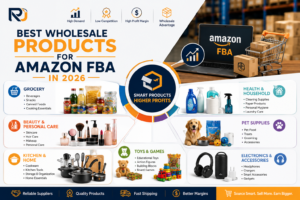
- https://reliabledistributorsllc.com/best-wholesale-products-for-amazon-fba-in-2026/
Some categories worth researching include:
Grocery & Gourmet
Pet Supplies
Beauty & Personal Care
Home & Kitchen
Health & Household
Toys & Games
But remember: a good category does not automatically mean a good product.
Amazon FBA Wholesale vs. Private Label
This is one of the first decisions new sellers need to make.
Wholesale
You sell established branded products.
Better if you want:
- Existing demand
- Established brands
- Faster product research
- Less product development
Private Label
You build your own branded product.
Better if you want:
- More control over branding
- Your own product identity
- Long-term brand building
- Greater control over the listing
Neither model is automatically better.
It depends on your budget, experience and goals.
What About Amazon Product Fulfillment?
Once you have purchased inventory, you still need to get it to customers.
That’s where FBA comes in.
Amazon stores your inventory and handles the fulfillment process when customers place orders.
For wholesale sellers, this creates a simple workflow:
Wholesale Supplier → Inventory → Amazon FBA → Customer
If you want to understand this part separately, see our guide on Amazon Product Fulfillment.
One Mistake I See New Wholesale Sellers Make
They focus too much on finding a product.
They should be asking:
“Can I build a repeatable business around this product?”
That means checking:
- Can I reorder it?
- Is the supplier reliable?
- Is the margin still healthy after fees?
- Are there too many sellers?
- Does the price remain stable?
- Can I sell through the inventory quickly?
- Is the product restricted?
- Can I document where it came from?
A product can look excellent on a calculator and still be a poor business decision.
How to Start Amazon FBA Wholesale Without Overcomplicating It
Step 1 — Pick a category
Don’t research every Amazon category at once.
Start with one.
Step 2 — Build a product list
Research 20–30 products.
Step 3 — Remove weak products
Eliminate products with:
- Very low margins
- Heavy competition
- Poor sales history
- Difficult shipping
- Compliance concerns
Step 4 — Contact suppliers
Ask about:
- Wholesale price
- MOQ
- Inventory
- Invoice
- Shipping
- Brand requirements
Step 5 — Calculate the real profit
Use Amazon’s current fee information and Revenue Calculator.
Step 6 — Test before scaling
You don’t need to buy huge quantities immediately.
Test a manageable amount, track sales, then reorder based on actual performance.
Why Supplier Reliability Matters
Let’s say you finally find a product that sells well.
You sell 100 units.
Then the supplier disappears for three months.
Now your Amazon listing may still have demand, but you don’t have inventory.
That’s why supplier reliability can be just as important as product profitability.
A wholesale business needs both:
Good Products + Reliable Supply
Not one or the other.
Final Takeaway
There is still a real opportunity in Amazon FBA wholesale, but I would not approach it as a shortcut to easy money.
The sellers who build something sustainable usually pay attention to the less exciting parts:
- Supplier verification
- Product margins
- Amazon fees
- Inventory
- Documentation
- Competition
- Reordering
Amazon’s latest seller data shows that independent sellers are responsible for more than 60% of sales in Amazon’s store, with 75,000+ sellers exceeding $1 million in sales during 2025.
The opportunity is clearly there.
The question is whether the numbers work for the product you’re buying.
If you’re looking for a wholesale source for your Amazon business, explore Amazon Wholesale Suppliers USA or review our Amazon Wholesale & FBA Distributors guide before choosing a supplier.
FAQs
Is Amazon FBA wholesale profitable?
It can be, but profitability depends on product cost, Amazon fees, competition, shipping and sales velocity. There is no fixed profit margin that applies to every product.
How much money do I need for Amazon FBA wholesale?
There is no universal starting amount. Your budget depends mainly on product cost, minimum order quantity, shipping and how much working capital you need for reorders.
Is wholesale better than private label?
Not necessarily. Wholesale gives you access to established products, while private label gives you more control over your own brand. The better model depends on your goals and resources.
How do I find Amazon FBA wholesale suppliers?
Look for legitimate distributors that can provide proper business documentation, authentic inventory, competitive wholesale pricing and consistent supply.
Can beginners start Amazon FBA wholesale?
Yes, but beginners should start with research and small, carefully calculated inventory purchases rather than buying large quantities based only on a supplier’s projected profit.